


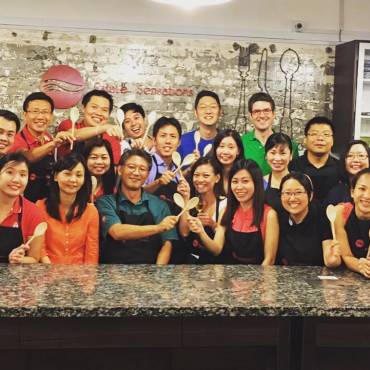
There is something quietly moving about watching a team of colleagues — accountants, engineers, executives, and interns standing side by side at a kitchen workstation — carefully packaging baked goods they made with their own hands, knowing every item in that box will reach someone who genuinely needs it.
That is corporate social responsibility at its best. Not a line item in the annual report, not a charity cheque signed by someone in finance who nobody ever sees, but something the team actually did together — with flour on their sleeves and a real sense of having contributed something worth contributing.
The evidence behind CSR and employee engagement has been accumulating for years. Studies consistently find that employees who feel their employer is genuinely invested in the wider community are more engaged, more loyal, and significantly more likely to stay. In Singapore’s competitive talent market — where replacing a single mid-level employee can cost anywhere from 50% to 200% of their annual salary once recruitment, onboarding, and the productivity dip are factored in — that connection is not soft data. It is a business consideration.
Here are seven ways to build a CSR programme that employees actually want to participate in, and that delivers something real to the communities your organisation serves.
Why CSR Is a Genuine Employee Engagement Tool
Corporate social responsibility is often framed as something companies do for external audiences — customers, regulators, prospective hires, the press. But its most consistent returns come from inside the business.
Research published in the Journal of Business Ethics and replicated across multiple organisational studies has found that employees who perceive their employer as socially responsible show significantly higher levels of commitment, engagement, and what researchers call “organisational citizenship behaviour” — meaning they go beyond their job description, support colleagues, and take genuine ownership of how the business performs.
This effect is especially pronounced among younger employees. Deloitte’s recent Gen Z and Millennial surveys have found that a meaningful share of younger workers factor a company’s social responsibility record into their employment decisions — both when choosing where to join and when deciding whether to stay. In Singapore, where multinationals compete directly with regional startups and government-linked companies for the same talent pool, a CSR programme that employees actually feel is not a nice-to-have. It is a competitive differentiator.
7 Ways to Engage Your Employees in CSR
1. Start Simple — and Make It Feel Accessible
The most common reason CSR programmes fail to gain traction is not lack of budget — it is lack of clarity. Employees do not know what is expected of them, how to participate, or whether their contribution actually matters. The fix is not a more ambitious programme. It is a simpler, clearer one.
A single afternoon baking together for a local charity is more powerful as a first step than an elaborate three-month initiative that nobody quite knows how to join. Start with one activity, one clear cause, and one tangible outcome your team can see for themselves. The habit builds from there.
2. Ask Your Team What They Care About
The fastest way to guarantee low participation is to choose a cause nobody on your team feels personally connected to. A brief internal survey — even three questions — will tell you a great deal about where your employees’ instincts actually point.
Some teams feel strongly about food security. Others are drawn to elderly welfare, youth education, or environmental causes. Knowing this before you choose your programme means the cause arrives with built-in advocates rather than polite indifference. It also signals something important to the team: that their opinions shaped the decision, not just the company’s PR calendar.

3. Turn CSR Into a Shared Team Experience
There is a meaningful difference between asking employees to donate to a cause and inviting them to participate in one together. The first is a transaction. The second is an experience — and shared experiences are what build the kind of interpersonal connection that survives a difficult quarter, a restructuring, or a long stretch of remote work.
The most effective CSR activities for corporate groups involve doing something tangible together: packing goods, building something useful, or — as any team that has tried it will confirm — baking cookies and muffins for someone who genuinely needs them more than you do.
Palate Sensations’ Bake for a Cause is a structured CSR baking programme designed specifically for corporate groups in Singapore. Participants bake a selection of goods — chocolate chip cookies, blueberry muffins, oatmeal cookies, lemon pound cakes, carrot loaf cakes, orange madeleines, and more — which are then donated to registered charities including The Food Bank Singapore and the Red Cross Home for the Disabled. The Food Bank can also collect and distribute on your behalf if needed.
Sessions run for 2 hours and accommodate up to 70 participants across 10 dedicated workstations. Pricing starts from $120 nett per person. An optional 3-course meal cooked by the Palate Sensations chefs can be added for $48 per person. All ingredients, equipment, aprons, and professional chef instruction are included. Halal-friendly options are available on request. No service charge. No GST.
4. Let Leadership Go First
CSR initiatives visibly championed by management carry significantly more weight than those delegated to an HR circular. When a senior director rolls up their sleeves to pipe icing alongside their team, or a CEO participates in packaging goods for donation rather than simply approving the budget for someone else to do it, the message lands in a way no internal campaign strategy can replicate.
Participation from the top is not about optics. It is about demonstrating that the company’s stated values are held by the people who set its direction — not just printed in the company handbook and quietly forgotten by the second quarter.
5. Keep Communication Clear and Consistent
Employees who hear about CSR activities two days before they happen feel like an afterthought. Good internal communication makes people feel included in the planning, not just informed of the logistics at the last minute. Share the cause in advance. Tell people what their participation will actually achieve. And after the event, close the loop.
Let the team know how many bakes were delivered, which charity received them, and what impact their afternoon made. That last step is the one most organisations skip — and it is also the one that most reliably turns a one-time participant into a genuine advocate for the next initiative.

6. Recognise the People Who Care Most
Every organisation has people who feel especially strongly about certain causes — the colleague who volunteers on weekends, the team member who quietly organises the pantry fundraiser, the manager who always knows which charity is doing genuinely useful work in the community. These are your CSR champions, and recognising their contribution — publicly, genuinely, without making it awkward — amplifies both their commitment and the wider team’s sense that the programme actually matters.
Recognition does not have to be grand. A mention in the team meeting, a note in the company newsletter, or a straightforward thank-you from the CEO goes further than most organisations realise. People contribute more when they can see that their contribution has been noticed.
7. Build It Into the Calendar — Not Just the Annual Report
A single CSR afternoon each year is better than nothing. But the organisations that see the strongest returns on employee engagement are those that build regular touchpoints into the working calendar — a quarterly bake, a biannual volunteer session, a festive-season giving initiative.
The goal is for CSR to feel like part of the culture, not an annual obligation that requires extensive persuasion to fill the participant list. A two-hour baking session for a team of 30 can be planned, facilitated, and fully donated within a single afternoon — and the engagement effects, according to Gallup’s ongoing research on employee well-being and social connection, tend to persist meaningfully in the weeks that follow.
Why Baking for a Cause Works So Well for Corporate Teams
Of all the formats a CSR activity can take, baking has a particular advantage: the outcome is something tangible, edible, and genuinely useful. Every batch of muffins baked means real food reaching people who need it. Every box of cookies carries a note of encouragement from the team that made it. The cause and the craft connect in a way that abstract giving — a donation button, a charity raffle, a percentage of annual profits — rarely achieves.
It is also, as any team that has tried it will readily confirm, unexpectedly good fun. Baking has a way of equalising people. The senior executive who has never held a piping bag and the junior analyst who bakes every Sunday are working at the same table, figuring it out together, and usually laughing by the second batch — at least one of which is always more rustic than planned, through no fault of the team.
The combination of shared laughter, purposeful output, and a real community beneficiary makes baking one of the most effective CSR formats available to corporate groups of any size or industry.
For a closer look at how CSR team building translates to measurable community impact in Singapore, our article on how cooking for a cause creates real impact explores the outcomes beyond the afternoon. And if you are interested in the gifting dimension of corporate baking — how a box of homemade goods can become a meaningful expression of company values — our piece on the art of giving through Bake for a Cause covers that story in full.
Key Takeaways
- CSR participation directly improves employee engagement, loyalty, and organisational commitment — the research evidence behind this connection is consistent and substantial
- The most effective CSR programmes start simply and make participation feel personal, accessible, and genuinely meaningful rather than obligatory
- Asking employees what causes they care about before choosing a programme significantly increases engagement and buy-in from the start
- Turning CSR into a shared team experience — baking, building, or cooking together — delivers team cohesion alongside community impact
- Recognising champions, communicating outcomes, and building CSR into the regular calendar separate programmes that are felt from programmes that are filed
- Palate Sensations’ Bake for a Cause programme runs for 2 hours, accommodates groups of up to 70, and starts from $120 nett per person — with all baked goods donated to registered charities including The Food Bank Singapore
Frequently Asked Questions About CSR Employee Engagement
What is CSR in the context of employee engagement?
In this context, CSR refers to structured activities that give employees an opportunity to contribute to the wider community as part of their working life — rather than through purely individual personal time. CSR activities integrated into the workplace calendar tend to have a stronger positive impact on morale, engagement, and organisational pride than standalone external programmes, because employees experience the contribution as part of who they work for, not simply who they happen to be as individuals.
How does the Bake for a Cause programme work?
Bake for a Cause is a 2-hour CSR baking programme run at Palate Sensations’ studio in Biopolis, Singapore. Corporate groups of up to 70 participants bake a selection of goods — cookies, muffins, loaf cakes, madeleines, and more — under the guidance of professional chefs. The baked items are donated to registered charities including The Food Bank Singapore and the Red Cross Home for the Disabled. The Food Bank can also arrange collection and distribution on your behalf. Pricing starts from $120 nett per person, with an optional 3-course meal add-on available. All ingredients and equipment are included.
Which charities benefit from Bake for a Cause?
Baked goods can be donated to a charitable organisation of your company’s choosing, or The Food Bank Singapore can collect and distribute on your behalf to their network of beneficiary organisations. For companies that require it for internal CSR reporting, documentation of the donation is available upon request — which can be useful for annual CSR reports, HR records, and company award submissions.
Is CSR team building suitable for large corporate groups?
Yes. Palate Sensations’ studio at Biopolis accommodates up to 70 participants across 10 dedicated workstations — suitable for department events, company-wide occasions, and everything in between. For groups larger than 70, or for teams that would prefer an offsite or multi-session format, the Palate Sensations team is happy to discuss alternatives suited to your group size and objectives. Dietary requirements including halal options can be accommodated with advance notice.
How do we measure the impact of a CSR team building activity?
Impact from a CSR team building activity can be measured in two directions: community impact (bakes donated, beneficiaries reached, charities supported) and internal impact (engagement survey scores, absenteeism rates, retention figures). A practical starting point is a brief pre/post pulse survey — three to five questions run before and again four to six weeks after the activity. Many organisations find the most telling signal is qualitative: the quality of conversations and collaboration in the office the week after a well-run CSR session is often noticeably different from the week before.
Read More
These articles explore related themes in more depth:
- CSR Team Building in Singapore: How Cooking for a Cause Creates Real Impact — the numbers behind the giving and what happens to the bakes after they leave the studio
- The Art of Gift Giving: Corporate Social Responsibility and Bake for a Cause — how purposeful baking creates meaningful corporate gifts and a genuine culture of generosity
Ready to Give Your Team Something Worth Baking For?
If you are looking for a CSR activity that combines genuine community impact with meaningful team connection — something your colleagues will remember long after the session ends — we would love to help you plan it.
Palate Sensations has been facilitating corporate team building and CSR baking sessions in Singapore since 2005. Come with a team. Leave with a story, a warm sense of having done something good together, and a rather satisfying number of muffins delivered to people who needed them.
Get in touch with us to discuss your group size, preferred dates, and the cause closest to your team’s heart. We will put together a tailored proposal for you.
About the Author: Lynette Foo is the founder of Palate Team Building Singapore and a formally trained culinary professional with a background from Le Cordon Bleu Paris. With over 20+ years of experience facilitating corporate team building events for more than 500 multinational and local companies in Singapore, Lynette combines deep culinary expertise with a practical understanding of team dynamics, workplace engagement, and experiential learning. Last updated: May 2026.

Add Comment