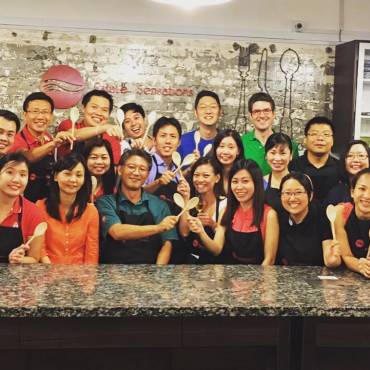
Cooking team building activities give a Singapore team five practical things: clearer communication, stronger trust, visible natural leadership, better problem-solving under pressure, and a genuine shared memory that keeps people connected back at the office. Cooking team building is a chef-guided corporate activity where colleagues plan, cook, and plate a meal together — turning teamwork from a slide on a screen into something they actually have to do, with a meal to show for it at the end.
Most managers do not book a cooking session because they want their team to learn to julienne a carrot. They book it because something at work needs fixing — a team that has gone quiet, a merged department that has not gelled, or a hard-working group that simply deserves a better afternoon than another meeting. The good news is that a well-run kitchen delivers on all three, often faster than you would expect.
This guide covers what cooking team building Singapore actually does for a team — the specific outcomes, who it helps most, and what your people take back to their desks on Monday. Palate Team Building has run these sessions in Singapore since 2005 for more than 500 companies, so this is drawn from watching a great many teams walk in as strangers and leave as something closer to a team.
Table of Contents
- What is a cooking team building activity?
- What teams learn from cooking together
- How does cooking improve team communication?
- How cooking reveals leadership and keeps teams productive
- How does cooking team building strengthen company culture?
- Who benefits most from cooking team building?
- Frequently asked questions
 What is a cooking team building activity?
 What is a cooking team building activity?
A cooking team building activity is a corporate bonding session where a team prepares food together — cooking a multi-course meal, competing in a timed challenge, or baking for a cause — with professional chefs guiding the whole experience. Unlike a normal cooking class that simply teaches a recipe, a team-building session is built around a shared challenge, so collaboration becomes a practical necessity rather than a talking point.
At Palate Team Building, sessions run at our Biopolis studio through Palate Sensations Cooking School, our affiliated culinary school, and no prior cooking skill is needed. The activity is deliberately low-pressure and inclusive — there is always a job for everyone, from the confident cook to the colleague who usually specialises in supervising. For a fuller look at why cooking works so well as a format, our post on cooking as a corporate team building activity goes deeper.
What Teams Learn From Cooking Together
Cooking together develops the everyday workplace skills that are hard to teach in a meeting room — because a kitchen forces a team to practise them in real time. Here is what participants reliably take away from a session, and why each one matters back at work:
- Clear communication under mild pressure — with a dish and a clock on the line, people learn to give and take direction without ego; the same habit shows up in the next tight project deadline
- Planning and coordination — teams have to sequence tasks, share limited stations, and keep an eye on timing, which is project management in miniature
- Natural leadership and support roles — the session quietly reveals who organises, who steadies the group, and who lifts everyone’s energy, often regardless of job title
- Adaptability — when the mystery ingredient lands or the plan slips, the team practises staying calm and adjusting together
- Trust and psychological safety — finishing something together in a low-stakes setting makes honest, higher-stakes conversations easier afterwards
- Creativity — away from KPIs, quieter colleagues often surprise everyone with strong opinions on flavour and presentation
This “What Teams Learn” list is the short answer many people are really searching for — a team does not just eat well, it rehearses the behaviours of a functional team, in a setting relaxed enough that the learning sticks.
How does cooking improve team communication?
Cooking improves team communication by giving people a shared, purposeful task that makes talking to each other necessary rather than awkward. When everyone is focused on whether the sauce needs more salt or who is plating the dessert, conversation starts naturally — there is always something useful to say, so even reluctant participants are drawn in within the first ten minutes.
There is evidence behind the effect, too. A well-known Cornell University study led by Kevin Kniffin found that groups who eat together perform measurably better as a team than those who do not. Cooking team building stacks the collaboration and the shared meal into one experience, which is part of why the change in a team’s warmth is so noticeable by the end of a session. The conversations that begin over a chopping board also tend to continue back at the office, which is where the real return shows up.
How cooking reveals leadership and keeps teams productive
 How cooking reveals leadership and keeps teams productive
A timed cooking challenge surfaces natural leadership and coordination in a way that ordinary work rarely does, because roles have to be assigned and decisions made quickly. The person who calmly keeps the whole station on schedule is often not the one with the most senior title — and knowing that about your team is genuinely useful.
Productivity gains follow from the same mechanism. Teams that have practised dividing work, communicating clearly, and adapting under a friendly time limit carry those habits back into real deadlines. It also gives structure to a group that has drifted: a clear goal, defined roles, and a satisfying finish line — three things a disengaged team is often missing. If your team has quietly gone flat, our guide on why choose culinary team building lays out how the format compares with escape rooms, outdoor days, and workshops.
How does cooking team building strengthen company culture?
Cooking team building strengthens company culture by creating shared experiences and cross-level relationships that everyday work does not naturally produce. When a manager chops onions beside a new hire and both laugh about the same near-disaster with the caramel, it does more for a sense of belonging than any values poster on the wall.
Culture is largely the sum of how people treat each other when no one is enforcing it — and those norms are set through informal, positive interactions. A shared meal is a small tradition that people remember and want to repeat, which is why many Singapore companies build a cooking session into their annual rhythm rather than treating it as a one-off. The bonds formed are also among the most durable retention factors an employer has: people are far more likely to stay somewhere they have genuine friendships.
Who benefits most from cooking team building?
Cooking team building benefits almost any corporate group, but it is especially effective for teams that need genuine reconnection rather than another lecture. Because the activity is inclusive and low-pressure, it fits a wide range of situations.
- New or newly merged teams — colleagues meeting for the first time who need to break the ice quickly and naturally
- Hybrid and regional teams — people who collaborate on screens all year and are finally in the same room
- Mixed-seniority groups — where leaders cooking alongside staff does more for culture than any org chart
- Quieter, analytical departments — engineers, analysts, and introvert-friendly teams who relax over a shared task rather than forced networking
- Teams celebrating or resetting — a milestone worth marking, or a demanding quarter that deserves a warmer full stop than a group email
Why Palate Team Building?
 Why Palate Team Building?
Palate Team Building has designed and facilitated cooking team building in Singapore since 2005 — over 18 years of running corporate cooking events for more than 500 multinational and local companies, including Google, Meta, Standard Chartered, LVMH, Singtel, and the Ministry of Education Singapore. Every session is led by qualified in-house chefs and customised around your team’s size, objectives, and dietary needs, with halal ingredients available on request.
Our studio at Chromos, 10 Biopolis Road is a five-minute walk from Buona Vista MRT — a 2,000 sq ft air-conditioned space with ten cooking workstations that comfortably hosts groups of up to 70 participants, with undercover parking and both indoor and outdoor dining. Sessions typically run two to four hours, including time to sit down and enjoy the meal together, which is where the most natural bonding happens.
“There is something wonderfully revealing about watching colleagues plan, chop, cook, taste, and laugh together. By the end of the session, they have not only created a meal — they have shared an experience that feels far warmer than another afternoon in a meeting room.”
— Lynette Foo, Founder, Palate Team Building Singapore
Key Takeaways
- Cooking team building develops communication, planning, leadership, adaptability, trust, and creativity — the everyday skills that are hard to teach in a meeting
- Shared cooking and eating measurably improve team cooperation (Cornell / Kniffin research)
- It reveals natural leadership and gives drifting teams structure — a clear goal, defined roles, and a satisfying finish
- It strengthens culture through cross-level relationships and shared traditions, which also support retention
- It suits new, hybrid, mixed-seniority, and quieter teams, with no cooking experience required
Frequently Asked Questions About Cooking Team Building in Singapore
What does cooking team building actually do for a team?
Cooking team building gives a team clearer communication, stronger trust, visible natural leadership, better problem-solving under pressure, and a shared memory that keeps people connected afterwards. Because colleagues have to plan, cook, and plate a meal together against a gentle time limit, they practise real teamwork rather than just discussing it — and those habits carry back into everyday work.
Do participants need cooking experience?
None at all. Every session is guided step by step by professional chefs and designed for complete beginners. The only real requirement is a willingness to try, and even the most confirmed non-cooks tend to surprise themselves by the time the food reaches the plate.
How long does a cooking team building session take?
Most cooking team building sessions run between two and four hours, depending on the format. This includes the cooking or challenge itself plus dedicated time to sit down and share the meal, which is often where the strongest bonding happens. Shorter formats work well as a warm-up before a larger company event; longer challenges suit teams wanting a deeper experience.
Is cooking team building suitable for large corporate groups?
Yes. The Palate Team Building studio at Biopolis accommodates groups of up to 70 participants across ten cooking workstations, with indoor and outdoor space for dining. Smaller groups of 10 or more work well too, and larger company-wide events can be arranged through off-site and custom formats.
How soon do you see results after a cooking team building session?
Many teams notice a warmer, more open dynamic immediately — the conversations that start in the kitchen tend to continue at the office in the following days. Deeper shifts in communication and collaboration build over the following weeks, especially when leaders keep the momentum going with follow-up projects and regular social touchpoints.
Read More
These related articles explore how and why cooking builds stronger teams:
- Cooking as a Corporate Team Building Activity: More Than Just Fun and Games — why cooking works so well as a bonding format
- Why Choose Culinary Team Building? — how cooking compares with escape rooms, outdoor days, and workshops
Ready to See What Cooking Can Do for Your Team?
If your team could use a genuine reset — better communication, warmer relationships, and an afternoon everyone actually enjoys — we would love to help you plan it. Tell us your team size, your date, and what you are hoping to achieve, and we will match you to the right Palate Team Building programme.
Palate Team Building has been creating cooking team building experiences in Singapore since 2005. Come hungry, come curious, and bring your team. The aprons are ready.
Get in touch:
📍 Chromos #01-03, 10 Biopolis Road, Singapore 138670
📞 +65 8769 0968
✉️ info@palatesensations.com
About the Author: Lynette Foo is the founder of Palate Team Building Singapore and a formally trained culinary professional with a background from Le Cordon Bleu Paris. With over 18 years of experience facilitating corporate team building events for more than 500 multinational and local companies in Singapore, Lynette combines deep culinary expertise with a practical understanding of team dynamics, workplace engagement, and experiential learning. Last updated: July 2026.