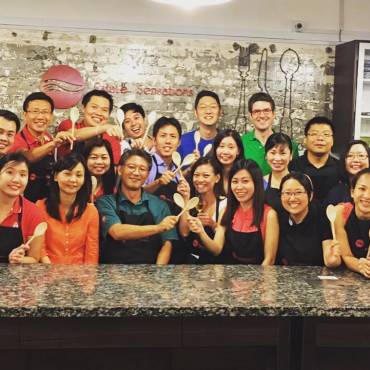
Companies choose culinary team building because it does something most corporate activities cannot: it gives colleagues a real, shared task with a delicious result at the end, and it builds trust while they are busy solving it. Culinary team building is a corporate bonding format where teams cook, bake, or plate a meal together under professional chef guidance — developing communication, planning, and leadership in a genuinely enjoyable setting rather than a manufactured one. It suits almost every group because everyone eats, and almost nobody has to perform.
There is a particular moment we see in nearly every session. A team walks into the studio a little unsure — some confident near the stove, some quietly hoping there is a job that does not involve the stove at all. Twenty minutes later, the same group is dividing tasks, rescuing a sauce, and arguing cheerfully about plating. By the time they sit down to eat what they made together, they are noticeably warmer with each other than when they arrived. That shift is the whole point — and it is surprisingly hard to manufacture any other way.
If you are weighing up culinary team building Singapore against escape rooms, outdoor games, or yet another off-site workshop, this guide is the honest version: what cooking together actually does for a team, how it compares with the alternatives, who it suits, what it costs, and where it is genuinely the wrong choice. Palate Team Building has run corporate cooking sessions in Singapore since 2005, so much of this comes from watching a lot of teams find their feet around a chopping board.
Table of Contents
- What is culinary team building?
- Why do Singapore companies choose culinary team building over other formats?
- What does cooking actually reveal about your team?
- Who is culinary team building best for?
- What culinary team building formats can you choose from?
- How much does culinary team building cost in Singapore?
- What makes Palate Team Building different?
- Frequently asked questions
What is culinary team building?
Culinary team building is a corporate team-building format in which a group prepares food together — cooking a multi-course meal, competing in a timed cooking challenge, baking for charity, or running a simulated restaurant — with professional chefs guiding the whole experience. The food is the vehicle; the real outcome is stronger communication, clearer collaboration, and the kind of trust that carries back into the office.
What makes it different from a normal cooking class is intent. A cooking class teaches you a recipe. Culinary team building is designed around a challenge — a time limit, a mystery ingredient, a target market, a judging panel — so that teamwork is not a slide on a screen but a practical necessity. Palate Team Building runs these sessions at our studio in Biopolis through Palate Sensations Cooking School, our affiliated culinary school, which means the cooking is credible and the bonding is deliberate. No prior kitchen skill is needed, which is a relief for the many participants whose signature dish is confidently ordering delivery.
Why do Singapore companies choose culinary team building over other formats?
Singapore companies choose culinary team building because it wins on the metric that actually matters — behaviour change that lasts after the day ends — while remaining genuinely inclusive across ages, fitness levels, and personalities. Most formats are fun on the day. Cooking is one of the few that keeps producing conversation back at the office, because the team made something together and has the photos, the in-jokes, and the meal to remember it by.
It also has a rare quality: everyone can take part without feeling exposed. An escape room can leave the quietest person standing at the back. An outdoor obstacle course quietly excludes anyone who is less mobile. A kitchen always has a job for everyone — chopping, timing, plating, tasting, cheerfully supervising — so participation happens naturally rather than by force. Here is how the common corporate formats compare on the things buyers actually ask about.
| Format | Everyone can take part? | Real talk-time between colleagues | Tangible result to keep | Lingers after the event? | Good for mixed seniority? |
|---|---|---|---|---|---|
| Culinary team building | Yes — a job for every skill level | High — constant, purposeful | A shared meal, recipes, photos | Strong — teams keep referencing it | Excellent — leaders cook alongside staff |
| Escape room | Partly — dominant voices can take over | Medium — bursts of problem-solving | A completion time | Moderate — fades quickly | Fair |
| Outdoor / sports day | Varies — fitness-dependent | Medium — often in sub-groups | A result or score | Moderate | Fair — physical gaps show |
| Workshop / seminar | Yes, but passive | Low — mostly listening | Notes or a framework | Weak without follow-through | Good |
| Drinks / social night | Yes | High but unstructured | None | Weak — cliques stay cliques | Fair |
None of this means the alternatives are bad — an escape room is a great afternoon, and there is nothing wrong with a social night. It means that if your goal is a team that communicates better on Monday, cooking is unusually good at delivering it. For a wider decision framework across cooking, escape rooms, and outdoor games, our guide to what cooking team building does for your team goes deeper on the specific outcomes.
 What does cooking actually reveal about your team?
 What does cooking actually reveal about your team?
Cooking under a gentle time constraint reveals how a team really coordinates, communicates, and makes decisions when the plan changes — the exact behaviours that are hard to observe in a meeting room. Roles emerge on their own. The person who quietly keeps the whole station on schedule is often not the one with the senior title, and that is genuinely useful to see.
There is real science underneath the fun, too. A well-known Cornell University study led by Kevin Kniffin found that groups who eat meals together perform measurably better as a team than those who do not — shared eating builds cooperation in a way that is difficult to replicate through talk alone. Cooking together adds the collaboration and the meal, which is part of why the effect feels so noticeable by the end of a session. We unpack the behavioural side of this in our article on the psychology behind team building through cooking.
In practice, a good culinary session surfaces four things reliably:
- Communication under mild pressure — who listens, who coordinates, and who asks for help without ego
- Natural leadership — who steps up to organise, and who supports rather than commands
- Adaptability — who stays calm when the mystery ingredient arrives and the plan has to change
- Trust — the quiet confidence that comes from finishing something together, which carries straight back into next week’s harder conversations
Who is culinary team building best for?
Culinary team building works best for teams that need genuine connection rather than another lecture — and it is especially effective for groups where not everyone knows each other, or where the usual social channels have gone quiet. Because the activity is inclusive and low-pressure, it suits a broad range of corporate scenarios.
- New or newly merged teams — colleagues meeting for the first time who need to break the ice quickly and naturally
- Hybrid and regional teams — people who collaborate on screens all year and are finally in the same room
- Mixed-seniority groups — where a manager chopping onions beside a new hire does more for culture than any org chart
- Introvert-friendly departments — analysts, engineers, and quieter teams who dread networking but relax over a shared task; our fun team bonding activity formats are built for exactly this
- Teams celebrating or resetting — a milestone worth marking, or a hard quarter that needs a warmer full stop than a group email
Where is it the wrong choice? Two honest cases. If your team has a serious, specific conflict that needs resolving, a cooking session will paper over it, not fix it — bring in facilitation first. And if half your group has significant dietary or mobility needs you have not flagged, tell us early so we can design around it rather than hope for the best. Handled well, both are easy. Ignored, they take the shine off an otherwise lovely day.
What culinary team building formats can you choose from?
Palate Team Building offers several culinary formats, from light and social to genuinely competitive, so the experience matches your team’s energy and goals. All of our in-studio team building programs are professionally facilitated by experienced chefs and can be customised around group size, dietary needs, and how much friendly competition your team can handle.
- Let Your Hair Down (Fun) — the accessible favourite. Teams cook a three-course meal, bake, run a fine-dining simulation, or take a wine, spirits, or cocktail class, then compete for the judging podium. Ideal for first-timers and mixed groups.
- The Challenge / Mystery Box — a MasterChef-style cooking competition against the clock, with a mystery protein, a supermarket spread of supplementary ingredients, and a one-minute presentation. Best for teams ready for higher stakes and a bit of drama.
- Bake for a Cause — a CSR-focused format where teams bake goods that are donated to charity, combining team bonding with something meaningful to take away beyond the photos.
- Culinary Murder Mystery — cooking plus theatre, where teams solve a themed mystery while preparing a meal. A memorable pick for groups who enjoy a little performance with their food.
Sessions typically run two to four hours, including time to sit and eat together — which, in our experience, is where the most natural team bonding actually happens. The studio has ten fully equipped cooking workstations and comfortably accommodates groups of up to 70 participants, with larger and off-site formats available on request.
How much does culinary team building cost in Singapore?
Culinary team building with Palate Team Building costs between S$98 and S$150 nett per participant in 2026, depending on the format you choose. All prices are nett — there is no service charge and no GST added on top — and every session includes chef facilitation, all ingredients and equipment, aprons, and iced water, coffee, and tea throughout.
- Delivery Service Challenge — from S$98 nett per participant (3-hour activity)
- Art Jamming & Tea Snacks — S$98 nett per participant
- Fun formats (Eat, Bake, Drink) — S$130 nett per participant
- Dine (fine-dining restaurant simulation) — S$140 nett per participant
- Mystery Box Challenge — S$135 nett per participant, or S$150 with an additional chef-cooked three-course meal
Optional add-ons — a drinks and hospitality package, canapés, a professional photographer, or a magician — are available if you want to make a larger event feel special. A 50% deposit confirms your date, with the balance settled at the end of the event.
What makes Palate Team Building different?
Palate Team Building has designed and facilitated culinary team building in Singapore since 2005 — over 18 years of running corporate cooking events for more than 500 multinational and local companies, including Google, Meta, Standard Chartered, LVMH, Singtel, and the Ministry of Education Singapore. Every session is led by qualified in-house chefs, and each programme is customised around your team’s size, objectives, and dietary requirements, with halal ingredients available on request.
Our studio sits at Chromos, 10 Biopolis Road — a five-minute walk from Buona Vista MRT, with undercover parking and both indoor and outdoor dining space. It is a 2,000 sq ft air-conditioned space with ten workstations, purpose-built for corporate groups rather than squeezed around a domestic kitchen. In short: the cooking is credible, the facilitation is professional, and nobody leaves hungry.
“There is something wonderfully revealing about watching colleagues plan, chop, cook, taste, and laugh together. By the end of the session, they have not only created a meal — they have shared an experience that feels far warmer than another afternoon in a meeting room.”
— Lynette Foo, Founder, Palate Team Building Singapore
Key Takeaways
- Culinary team building is a chef-guided corporate bonding format where teams cook, bake, or plate a meal together to build communication, planning, and trust
- It out-performs escape rooms, outdoor days, and seminars on inclusivity and on how long the bonding lasts after the event
- Cooking reveals communication, leadership, adaptability, and trust — and shared meals measurably improve team cooperation (Cornell / Kniffin research)
- It suits new, hybrid, mixed-seniority, and introvert-friendly teams; it is the wrong tool for unresolved serious conflict
- Formats range from light and social to MasterChef-style competition, CSR baking, and culinary murder mystery
- Costs run S$98–S$150 nett per participant in 2026, with no service charge or GST
Frequently Asked Questions About Culinary Team Building in Singapore
Why should a company choose culinary team building over an escape room?
Companies choose culinary team building over an escape room mainly for inclusivity and lasting impact. A kitchen gives every personality and skill level a natural role, so participation does not depend on the loudest voice or the fastest puzzle-solver. It also produces a shared meal, recipes, and photos that keep the experience alive in conversation back at the office — where escape-room bonding tends to fade within a week.
Do participants need any cooking experience?
None at all. Every session is guided step by step by professional chefs, and the programmes are designed for complete beginners. The only real requirement is a willingness to try — and in our experience, even the most confirmed non-cooks tend to surprise themselves by the time the food is on the plate.
How long does a culinary team building session take?
Most culinary team building sessions run between two and four hours, depending on the format. This includes the cooking or challenge itself plus dedicated time to sit down and share the meal together, which is often where the strongest team bonding happens. Shorter formats work well as a warm-up before a larger company event; longer challenge formats suit teams wanting a deeper, more immersive experience.
Is culinary team building suitable for introverts?
Yes — this is one of its real strengths. Because everyone is focused on a shared task rather than being put on the spot socially, quieter team members usually find cooking far more comfortable than networking or group-sharing formats. There is always something useful to do, so conversation happens naturally instead of feeling like a performance.
How many people can join a culinary team building session?
Our Biopolis studio comfortably accommodates groups of up to 70 participants across ten cooking workstations, with additional indoor and outdoor space for dining. Smaller groups of 10 or more work beautifully, and larger company-wide events can be arranged through off-site and custom formats. We are happy to recommend the right setup during an initial conversation.
Can dietary requirements be accommodated?
Yes. Vegetarian, allergy, and other dietary needs can be planned for in advance, and halal ingredients are available on request. We are not halal certified, but pork and lard can be removed from menus and the studio can be cleansed according to Muslim ritual if required. Please share any requirements at least one week before your event so we can plan properly.
Read More
These related articles go deeper on how and why cooking builds stronger teams:
- The Psychology Behind Team Building Through Cooking — what the research says about why shared cooking builds trust and cooperation
- What Can Cooking Team Building Activities in Singapore Do for Your Team? — the specific outcomes teams take back to the office
Ready to Cook Up a Stronger Team?
If you want a team-building experience that everyone can join, that people actually talk about afterwards, and that ends with a meal instead of a debrief slide — we would love to help you plan it. Tell us your team size, your date, and what you are hoping to achieve, and we will match you to the right Palate Team Building programme.
Palate Team Building has been creating culinary team building experiences in Singapore since 2005. Come hungry, come curious, and bring your team. The aprons are ready.
Get in touch:
📍 Chromos #01-03, 10 Biopolis Road, Singapore 138670
📞 +65 8769 0968
✉️ info@palatesensations.com
About the Author: Lynette Foo is the founder of Palate Team Building Singapore and a formally trained culinary professional with a background from Le Cordon Bleu Paris. With over 18 years of experience facilitating corporate team building events for more than 500 multinational and local companies in Singapore, Lynette combines deep culinary expertise with a practical understanding of team dynamics, workplace engagement, and experiential learning. Last updated: July 2026.